Updated: 16 May 2026
Indian investors are becoming cautious again.
After months of market volatility in 2026, many families are shifting part of their money toward fixed deposits for stability and predictable returns. At the same time, Small Finance Banks are attracting attention because some of them are offering FD rates above 8%.
That naturally creates an important question:
Are Small Finance Bank FDs actually safe?
Many investors now compare:
- SFB FD rates
- SBI FD safety
- HDFC and ICICI fixed deposits
- DICGC insurance protection
- emergency fund safety
The confusion is understandable.
Higher FD rates look attractive, especially for:
- retirees
- senior citizens
- conservative savers
- middle-class families protecting emergency money
But safety matters more than interest rate alone.
This guide explains:
- how safe Small Finance Bank FDs are in 2026
- how DICGC insurance works
- differences between SFBs and large banks
- real risks investors should understand
- practical FD diversification strategies for Indian households
Disclaimer: FD rates, bank policies, and regulations may change. Verify latest details from official bank websites, RBI, and DICGC before investing. Educational content only.
Why Are Small Finance Bank FD Rates Higher?
This is the first thing most investors notice.
Some Small Finance Banks are offering FD rates above:
- 8%
- 8.25%
- even 8.5% on selected tenures
Meanwhile, large banks like:
- SBI
- HDFC Bank
- ICICI Bank
usually remain closer to:
- 6.5% to 7.25%
depending on tenure and customer category.
That difference attracts depositors quickly.
But higher FD rates do NOT automatically mean a bank is unsafe.
Small Finance Banks are still expanding aggressively and need to attract deposits faster than large established banks. Offering higher interest rates is one way to grow their deposit base.
Large banks already have:
- massive customer networks
- stronger liquidity
- larger deposit pools
- stronger public trust
So they do not need to compete aggressively on FD rates.
What Is a Small Finance Bank?
Small Finance Banks are RBI-regulated banks created to improve banking access in underserved segments of India.
They can:
- accept deposits
- offer fixed deposits
- provide savings accounts
- issue debit cards
- provide loans
- offer digital banking services
Examples include:
- AU Small Finance Bank
- Unity Small Finance Bank
- Suryoday Small Finance Bank
- ESAF Small Finance Bank
- Ujjivan Small Finance Bank
One important point:
Small Finance Banks are regulated banks, not unregulated deposit schemes or finance companies.
They operate under RBI banking regulations and must follow rules related to:
- capital adequacy
- liquidity management
- CRR and SLR requirements
- prudential norms
- priority sector lending obligations
This regulatory framework is one reason SFB deposits remain part of India’s formal banking system.
Are Small Finance Bank FDs Covered by DICGC?
Yes.
This is one of the most important facts investors should understand before comparing FD safety.
Deposits in eligible Small Finance Banks are covered under:
DICGC insurance
DICGC stands for:
Deposit Insurance and Credit Guarantee Corporation
It operates under the RBI framework.
What Does the ₹5 Lakh DICGC Cover Mean?
Many depositors misunderstand this rule.
The insurance limit is:
₹5 lakh per depositor per bank
And this includes:
- principal
- accumulated interest
together.
Example:
If you have:
- ₹4.8 lakh FD
- ₹35,000 interest
Total deposit value becomes:
₹5.15 lakh
In this case, DICGC protection applies up to ₹5 lakh.
Important DICGC Rule Most Investors Miss
DICGC coverage applies:
per depositor per bank
NOT:
- per FD
- per account
- per branch
This means:
If a person keeps:
- ₹10 lakh
- ₹15 lakh
- ₹20 lakh
inside one single bank,
the amount above ₹5 lakh remains outside insurance coverage.
This applies to:
- Small Finance Banks
- SBI
- HDFC Bank
- ICICI Bank
- most insured banks in India
Are SFB FDs as Safe as SBI or HDFC FDs?
This question needs a balanced answer.
Technically:
- both are RBI regulated
- both are covered under DICGC insurance
- both operate inside India’s banking framework
But practically, many investors still perceive differences.
Large banks like:
- SBI
- HDFC Bank
- ICICI Bank
usually have:
- larger balance sheets
- wider branch networks
- stronger public trust
- larger customer bases
- longer operating history
Small Finance Banks are smaller institutions and often focus more heavily on:
- retail lending
- small borrowers
- MSMEs
- underserved sectors
That does NOT automatically make them unsafe.
But because they are smaller institutions, deposit concentration and liquidity planning become more important for households parking large sums.
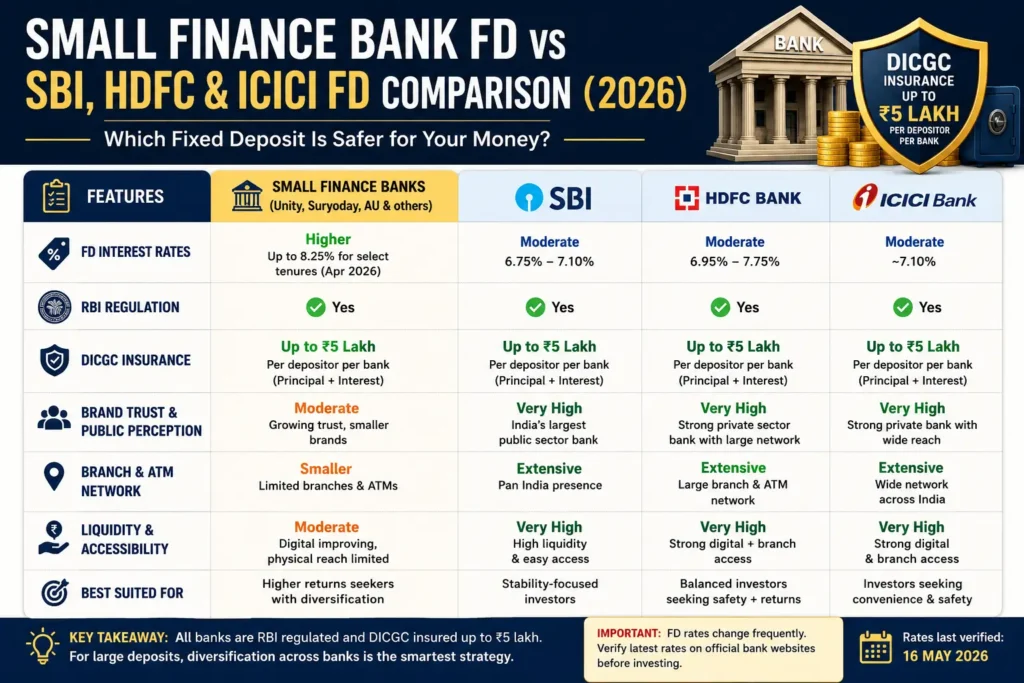
SFB FD vs SBI, HDFC & ICICI FD Comparison (2026)
| Feature | Small Finance Banks | SBI / HDFC / ICICI |
|---|---|---|
| FD Rates | Usually higher | Usually lower |
| RBI Regulation | Yes | Yes |
| DICGC Protection | Up to ₹5 lakh | Up to ₹5 lakh |
| Public Trust | Moderate to growing | Very strong |
| Branch Network | Smaller | Extensive |
| Liquidity Comfort | Moderate | Higher |
| Emergency Fund Suitability | Partial allocation | Strong |
| Best For | Higher-rate seekers with diversification | Stability-focused savers |
FD Rates Snapshot (Last Verified: 16 May 2026)
| Bank | Approx FD Rate |
|---|---|
| Suryoday SFB | Up to 8.25% |
| Unity SFB | Around 8.00% |
| AU SFB | Around 7.5%+ |
| SBI | Around 6.75%–7.10% |
| HDFC Bank | Around 6.95%–7.75% |
| ICICI Bank | Around 7.10% |
Rates vary based on tenure, customer category, and bank policy. Always verify latest official rate cards before investing.
Why SFBs Can Offer Higher Rates
Small Finance Banks were designed to serve:
- underserved borrowers
- small businesses
- rural and semi-urban customers
- microfinance segments
Because they are still expanding their deposit base, they often compete more aggressively for retail deposits.
That is one reason many SFBs offer higher FD returns than large banks.
Higher rates usually reflect:
- growth strategy
- deposit acquisition needs
- smaller scale operations
not automatic financial weakness.
What Are the Real Risks of SFB FDs?
The discussion should not become:
- “safe”
or - “unsafe”
The better approach is understanding practical risks.
1. Deposit Concentration Risk
Keeping very large amounts in one bank increases exposure.
Especially for:
- retirees
- emergency reserves
- senior citizen lifetime savings
Diversification matters more than chasing every extra 0.5% return.
2. Liquidity and Accessibility
Large banks usually offer:
- wider branch access
- larger ATM networks
- stronger operational familiarity
Some investors value that convenience and comfort.
3. Business Concentration Risk
Many SFBs lend more aggressively toward:
- MSMEs
- microfinance
- small borrowers
Economic slowdowns can affect these segments more heavily.
4. Emotional Comfort
This matters more than people admit.
Some investors simply feel calmer keeping emergency money in:
- SBI
- HDFC Bank
- ICICI Bank
That emotional comfort has real value in financial planning.
Who Should Consider Small Finance Bank FDs?
SFB FDs may suit:
- investors seeking higher FD rates
- diversified savers
- limited higher-yield allocations
- short-to-medium-term FD investors
They may work especially well when:
- deposits remain within planned limits
- money is diversified across banks
- emergency liquidity exists elsewhere
Who Should Be More Careful?
Extra caution may make sense for:
- retirees putting entire savings into one SFB
- households with weak emergency reserves
- investors crossing DICGC limits heavily
- families fully dependent on FD income
For such households:
- stability
- diversification
- liquidity
matter more than maximizing yield.
Smart FD Diversification Strategy
Instead of chasing only the highest FD rate, many households may benefit more from:
diversified FD planning
Example:
| Purpose | Suggested Placement |
|---|---|
| Emergency liquidity | SBI/HDFC savings + sweep FD |
| Core stable reserve | Large bank FD |
| Higher-yield allocation | Limited SFB FD exposure |
| Long-term allocation | Diversified mix across banks |
This approach reduces:
- concentration risk
- liquidity pressure
- panic during uncertainty
FD Laddering Strategy Example
Instead of locking all money into one FD:
Split deposits across:
- 1 year
- 2 years
- 3 years
- 5 years
This creates:
- periodic liquidity
- reinvestment flexibility
- better interest-rate adaptability
Especially useful during changing rate cycles.
Should Senior Citizens Use SFB FDs?
Some senior citizens do use them because:
- rates are attractive
- income needs are higher
- post-retirement returns matter
But retirees should usually avoid:
- putting entire retirement corpus into one bank
- chasing only highest rates
- ignoring DICGC limits
Balanced diversification is usually safer.
Biggest FD Mistakes Investors Make
Chasing Only Highest Rate
Higher return without diversification creates unnecessary exposure.
Ignoring DICGC Limits
Very common mistake.
Many depositors incorrectly assume insurance applies separately for every FD.
Locking Emergency Money for Long Tenures
Emergency liquidity should remain accessible.
Keeping Entire Savings in One Bank
Diversification reduces stress and concentration risk.
Practical Rule for Indian Families
For many households:
- stability
- liquidity
- emergency reserves
- diversification
matter more than maximizing every extra 0.5% FD return.
That mindset usually creates stronger long-term financial stability.
FAQs
Are Small Finance Bank FDs safe in India?
SFB FDs are RBI regulated and covered under DICGC insurance up to ₹5 lakh per depositor per bank.
What happens if a Small Finance Bank fails?
Eligible deposits remain protected under DICGC rules up to applicable insurance limits.
Is DICGC protection automatic?
Yes. Eligible insured bank deposits are automatically covered.
Does DICGC cover both principal and interest?
Yes. Total coverage includes both principal and accumulated interest together.
Is ₹10 lakh safe in one Small Finance Bank?
Only ₹5 lakh per depositor per bank falls under DICGC insurance coverage.
Are SBI FDs safer than SFB FDs?
Large banks generally have stronger public trust and larger balance sheets, although both operate under RBI regulation.
Why do Small Finance Banks offer higher FD rates?
Many SFBs offer higher rates to attract deposits and expand their customer base.
Should senior citizens invest in SFB FDs?
Some may choose limited exposure, but diversification is usually important for retirement savings.
Are FD returns guaranteed?
FD rates are fixed for the chosen tenure at the time of deposit, subject to bank terms and applicable conditions.
What is the safest FD strategy?
Diversification across banks, maintaining liquidity, and understanding DICGC limits generally improve safety.
Conclusion
Small Finance Bank FDs are not automatically unsafe.
They are:
- RBI regulated
- part of India’s banking framework
- covered under DICGC insurance limits
But investors should still understand:
- deposit concentration risk
- liquidity planning
- diversification
- insurance limits
For many Indian households, the smarter strategy is not:
- blindly chasing highest FD rates
or - avoiding SFBs completely
The better approach is balanced financial planning.
That means:
- diversifying deposits
- maintaining emergency liquidity
- understanding DICGC protection
- matching FD strategy with household needs
Higher returns matter.
But financial stability matters more.
Suggested Internal Links
- SIP During Market Fall in India
- Emergency Fund Guide
- PPF vs FD 2026
- Best Low-Risk Investments India
- FD Laddering Strategy
- Senior Citizen Investment Options
Suggested CTA
Download:
“2026 FD Safety & Emergency Money Checklist for Indian Families”
Includes:
- DICGC safety checklist
- FD diversification tracker
- emergency reserve planner
- FD laddering worksheet