
Updated: 15 May 2026
India’s financial mood in 2026 feels cautious.
Stock markets have become unstable. Gold prices are moving sharply. Fixed deposit rates remain attractive, but inflation is still affecting household budgets. Many Indian families are asking the same questions:
- Should I stop SIPs?
- Is FD safer now?
- Should I move money to gold?
- How much emergency fund is enough?
- Where should middle-class families keep savings during uncertainty?
This is not just about the stock market anymore.
For most households, market volatility affects:
- job confidence
- EMIs
- monthly savings
- retirement planning
- emergency preparedness
- insurance decisions
- long-term wealth building
A bad financial decision during uncertainty can take years to recover from.
But panic decisions are usually worse than market falls themselves.
This guide explains practical ways Indian families can protect savings, maintain liquidity, reduce financial stress, and avoid common mistakes during 2026 market volatility.
Disclaimer: Educational content only. Interest rates, taxation, and investment rules may change. Verify latest details from RBI, SEBI, AMFI, IRDAI, banks, or official providers before investing.
Why Are Indian Markets Volatile in 2026?
Several factors are affecting investor confidence in 2026.
1. Equity Market Corrections
Indian equity markets saw strong rallies during previous years. Many sectors became expensive, especially mid-cap and small-cap stocks.
Now markets are correcting.
This does not automatically mean a crash. But it increases fear among retail investors.
2. Global Uncertainty
International events continue affecting Indian markets:
- geopolitical tensions
- oil price fluctuations
- slowing global demand
- foreign investor selling
- US interest-rate expectations
Even families that never invest in stocks feel these effects indirectly through inflation, fuel prices, and EMI pressure.
3. RBI Interest Rate Signals
The RBI has maintained a cautious stance in 2026.
This matters because interest rates influence:
- FD returns
- loan EMIs
- debt fund performance
- housing demand
- borrowing costs
Many households are now balancing between:
- safety
- liquidity
- inflation protection
4. Household Cost Pressure
Middle-class expenses have increased:
- school fees
- rent
- healthcare
- insurance premiums
- groceries
- lifestyle spending
Even families earning decent salaries feel tighter monthly cash flow.
That changes investment behavior.
How Volatility Affects Different Indian Households
Not everyone experiences volatility in the same way.
Salaried Employee
Ravi, a 38-year-old IT employee in Hyderabad, earns ₹92,000/month.
He has:
- ₹28,000 EMI
- ₹15,000 SIP
- two children
- ₹4 lakh emergency savings
When markets fall, he becomes nervous about SIP losses.
His real risk is not temporary market decline.
His real risk is:
- stopping long-term investing
- having insufficient liquidity
- depending too much on salary stability
Freelancer
A freelancer faces a different problem.
Income itself becomes unpredictable.
During uncertain periods:
- client payments slow down
- projects reduce
- emergency cash becomes critical
For freelancers, liquidity matters more than maximizing returns.
Senior Citizens
Retired investors usually prioritize:
- capital safety
- monthly income
- low stress
- liquidity
Many senior citizens move too aggressively into FDs or unsafe high-return schemes during uncertain times.
Both can become dangerous.
Young Investors
Aggressive investors often believe:
“Markets always recover.”
That is partly true for long-term investing.
But many young investors ignore:
- emergency funds
- insurance
- cash reserves
- diversification
That creates forced selling during emergencies.
First Priority: Protect Cash Flow
During volatility, protecting cash flow matters more than chasing returns.
Many investors focus too much on:
- market timing
- gold prices
- SIP returns
But ignore:
- debt burden
- liquidity
- insurance gaps
- emergency planning
That is backwards.
Immediate Steps to Protect Savings
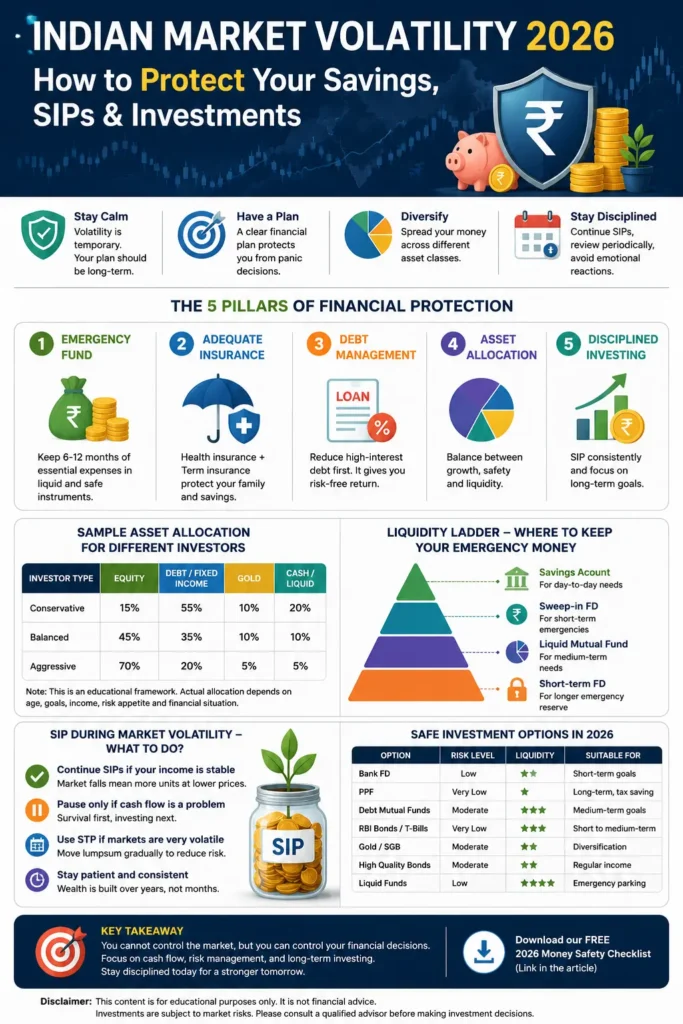
Build an Emergency Fund
Most Indian families should maintain:
- 6–12 months of essential expenses
- in liquid and low-risk form
Example:
If monthly essentials are ₹45,000:
- minimum emergency target = ₹2.7 lakh to ₹5.4 lakh
Freelancers may need:
- 12–18 months
Where Should Emergency Money Stay?
Do not keep everything in one place.
A simple liquidity ladder works better.
| Purpose | Suggested Location |
|---|---|
| Monthly expenses | Savings account |
| Short emergency cash | Sweep FD |
| Medium emergency reserve | Liquid fund |
| Long emergency reserve | Short-term FD |
This improves:
- liquidity
- flexibility
- emotional stability
Reduce High-Interest Debt First
Many Indians invest aggressively while carrying:
- credit card debt
- BNPL balances
- personal loans
This destroys cash flow.
A guaranteed 36% credit-card interest loss is worse than temporary market volatility.
Insurance Is Part of Wealth Protection
Many households underestimate this.
One hospitalization can wipe out years of savings.
At minimum:
- health insurance
- term insurance
- emergency cash
must exist before aggressive investing.
Should You Stop SIPs During Market Volatility?
This is one of the biggest mistakes investors make.
What Happens During Market Falls?
When markets decline:
- NAVs fall
- fear increases
- investors stop SIPs
- redemptions rise
But SIP investing works through rupee cost averaging.
That means:
- lower prices buy more units
- long-term averages improve over time
When Continuing SIPs Usually Makes Sense
Continuing SIPs is usually reasonable when:
- income is stable
- goals are long term
- emergency fund exists
- no urgent cash requirement exists
Examples:
- retirement
- child education
- 10+ year goals
When Pausing SIPs May Be Reasonable
Temporary SIP pause can make sense if:
- job loss risk increases
- income becomes unstable
- emergency fund is weak
- debt burden becomes dangerous
Cash flow survival comes before investing.
Always.
Common SIP Mistakes During Market Fear
Mistake 1:
Stopping SIP after a 10–15% correction.
Mistake 2:
Investing aggressively only after markets recover.
Mistake 3:
Using emergency money to “buy the dip.”
Mistake 4:
Watching portfolio values daily.
Mistake 5:
Copying social media financial influencers.
How Indian Families Should Allocate Money in 2026
Asset allocation matters more than predictions.
Most long-term financial success comes from:
- discipline
- diversification
- risk control
- consistency
Not from guessing markets.
Sample Asset Allocation Framework
| Investor Type | Equity | Debt/FI | Gold | Cash |
|---|---|---|---|---|
| Conservative | 15% | 55% | 10% | 20% |
| Balanced | 45% | 35% | 10% | 10% |
| Aggressive | 70% | 20% | 5% | 5% |
This is only an educational framework.
Real allocation depends on:
- age
- goals
- income stability
- family responsibilities
- risk tolerance
PPF vs FD vs Debt Funds in 2026
This is one of the most searched finance comparisons in India right now.
But there is no universal “best” option.
Each serves different purposes.
| Feature | PPF | FD | Debt Fund |
|---|---|---|---|
| Risk | Very low | Low | Moderate |
| Liquidity | Low | Medium | High |
| Tax Efficiency | Strong | Weak | Depends on holding |
| Lock-in | 15 years | Flexible | None |
| Returns | Government-set | Fixed | Market-linked |
| Best For | Long-term discipline | Stability | Medium-term parking |
Reality About Fixed Deposits in 2026
Many families are returning to FDs because:
- markets feel uncertain
- FD rates improved
- emotional comfort matters
But remember:
FD returns are taxable.
If inflation stays high, real post-tax returns may become weak.
FDs are useful.
But putting all savings into FDs creates:
- inflation risk
- opportunity loss
- concentration risk
Is Gold Safe in 2026?
Gold helps diversification.
But many Indians misunderstand gold.
Gold is not:
- guaranteed profit
- always stable
- a replacement for emergency funds
Gold works best as:
- portfolio hedge
- limited allocation
- long-term diversification tool
Most households do not need extremely high gold allocation.
30-Day Financial Protection Plan
First 30 Days
- Build emergency reserve
- Review insurance policies
- Reduce unnecessary expenses
- Check debt burden
- Avoid panic investment decisions
- Stop speculative trading
60-Day Financial Reset
- Review asset allocation
- Separate goals properly
- Rebalance investments
- Review SIP affordability
- Compare FD and debt allocation
- Check tax efficiency
90-Day Long-Term Stabilization
- Build annual budgeting system
- Create long-term investment rules
- Automate savings
- Increase emergency reserves
- Create goal-based investing structure
Real Example: Middle-Class Family Allocation
A family earning ₹1.2 lakh/month may structure finances like this:
| Category | Amount |
|---|---|
| Emergency fund | ₹5 lakh |
| SIPs | ₹20,000/month |
| FD reserve | ₹3 lakh |
| Insurance coverage | Health + Term |
| Gold exposure | 5–10% |
| EMI burden | Below 35% income |
This creates balance between:
- growth
- liquidity
- protection
Biggest Financial Mistakes During Volatility
Panic Selling
Temporary declines become permanent losses after panic selling.
Overexposure to One Asset
Too much:
- gold
- equity
- FD
- crypto
- real estate
creates concentration risk.
Ignoring Insurance
Many families invest aggressively but remain underinsured.
That is dangerous financial planning.
Confusing Saving With Investing
Savings protect short-term survival.
Investing builds long-term wealth.
Both matter.
Practical Rules for Indian Families in 2026
Rule 1:
Emergency fund first.
Rule 2:
Insurance before aggressive investing.
Rule 3:
Do not stop long-term SIPs emotionally.
Rule 4:
Diversification matters more than prediction.
Rule 5:
Liquidity reduces panic.
Rule 6:
Avoid financial decisions based on headlines.
FAQs
Should I stop SIP during market crash?
Usually no, if your income is stable and goals are long term.
Is FD safer than mutual funds?
FDs are lower volatility, but mutual funds may help long-term growth depending on the category and time horizon.
Is gold a safe investment now?
Gold helps diversification but should not dominate your entire portfolio.
How much emergency fund should Indian families keep?
Usually 6–12 months of essential expenses.
Freelancers may need more.
Is it good to invest during market fall?
Long-term investing during corrections can help disciplined investors, but emergency money should never be invested aggressively.
Conclusion
Market volatility feels uncomfortable because uncertainty creates fear.
But strong financial systems are built during uncertain periods, not easy periods.
Indian families usually perform better when they:
- protect liquidity
- maintain emergency reserves
- continue disciplined investing
- avoid emotional decisions
- diversify properly
- focus on long-term goals
Prediction is not the real advantage.
Financial stability is.
Suggested Internal Links for Kapizo
- Emergency Fund Guide
- SIP Beginner Guide
- PPF vs FD Detailed Comparison
- Best Low-Risk Investments India 2026
- Health Insurance Guide
- Asset Allocation by Age
Suggested CTA
Download:
“2026 Indian Family Money Safety Checklist”
Includes:
- emergency fund tracker
- SIP review sheet
- FD comparison notes
- monthly financial review template